











































































 SPP2395 PREMIER Wiki
Project 13 (2025-2028)
Spatiotemporally resolved microglial diversity and reciprocal interaction with the noradrenergic system in Alzheimer’s disease
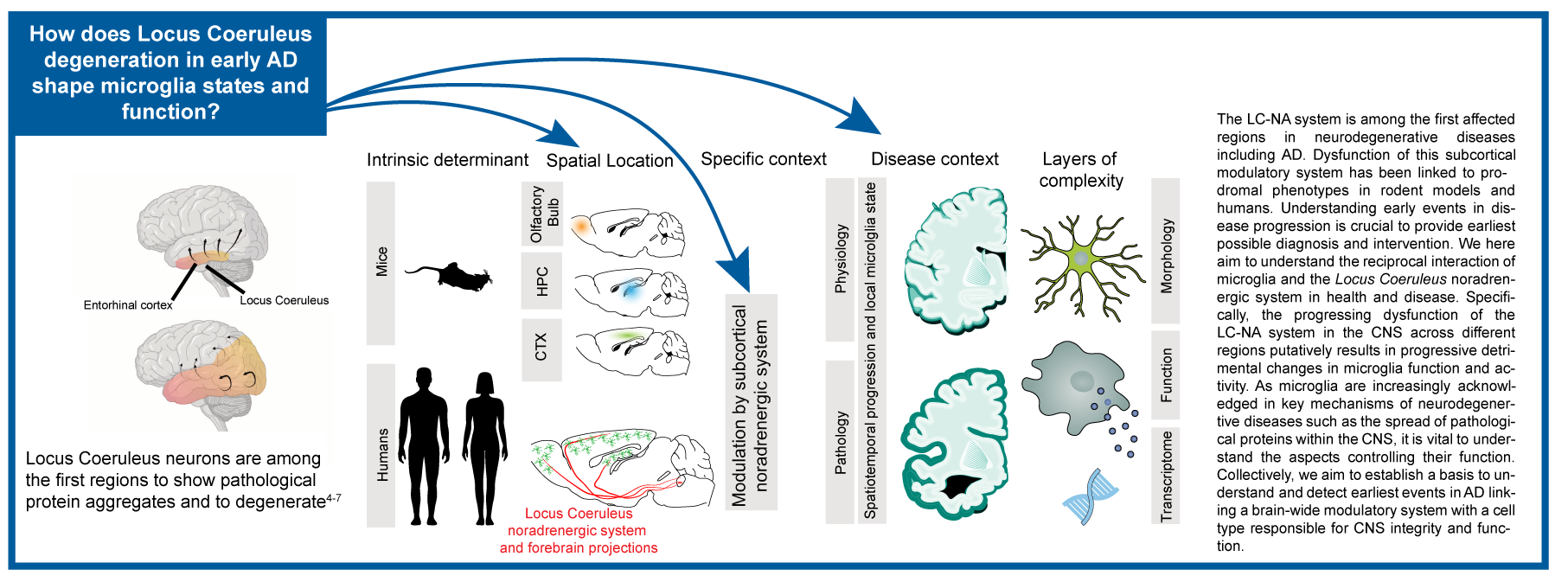
Alzheimer’s disease (AD) is the most common neurodegenerative disorder and is characterized by progressive cognitive decline that begins years before clinical symptoms become apparent. Increasing evidence suggests that microglia, the resident immune cells of the brain, are central regulators of disease progression. However, microglial responses in AD are highly heterogeneous and vary across brain regions and disease stages. The mechanisms driving these spatiotemporal differences remain poorly understood. This project investigates how microglial diversity is shaped by the noradrenergic system, particularly by projections from the locus coeruleus (LC), one of the earliest brain regions affected in AD. Our preliminary work revealed that early olfactory deficits in AD mouse models coincide with a selective loss of noradrenergic axons in the olfactory bulb and a striking increase in local microglial activity. These microglia display a previously transcriptomic state that differs from previously described “disease-associated microglia (DAM)”. Our data further suggest that microglia actively remove noradrenergic axons, at an ewarly timepoint exclusively in the olfactory bulb, through enhanced phagocytosis, thereby contributing to early circuit dysfunction and sensory impairment. The project combines advanced mouse genetics, chemogenetics, transcriptomics and in vivo two-photon imaging in mice, and spatial transcriptomics in human post-mortem tissue to dissect the reciprocal interaction between microglia and the noradrenergic system in physiology and pathology. Specifically, the project will determine how noradrenaline shapes microglial transcriptional states, how progressive loss of noradrenergic input alters microglial function during AD progression, and which molecular pathways mediate microglia-dependent axon degeneration.A strong translational component links the experimental findings to human disease. We will analyze olfactory bulb, hippocampal, and cortical tissue from prodromal AD patients and controls to identify spatially resolved microglial signatures associated with amyloid pathology and noradrenergic fiber loss. By integrating molecular, cellular, and functional approaches, the project aims to establish a comprehensive framework for understanding microglial heterogeneity in early AD. Ultimately, the project aims identify novel therapeutic strategies aimed at preserving noradrenergic signaling and modulating maladaptive microglial responses before irreversible neurodegeneration occurs.
Principal Investigators
Institutions